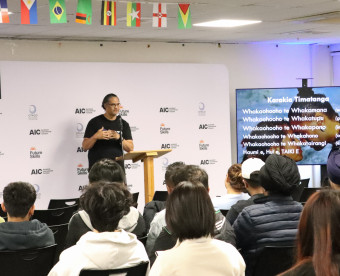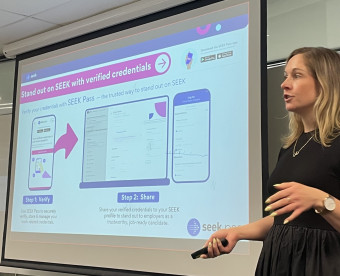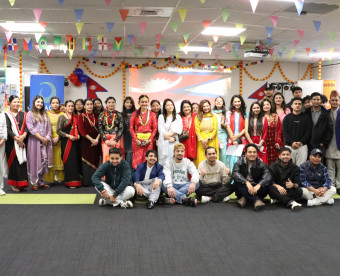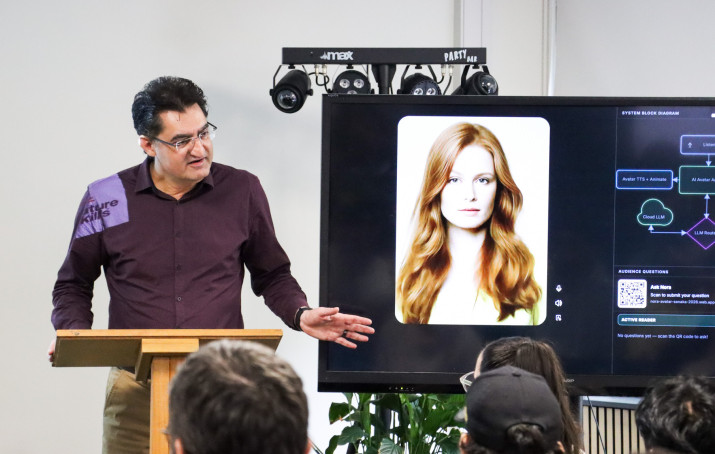
An international panel of academics and industry experts discussed global technology trends and career readiness with students and staff at Auckland International Campus on Friday.
The panel event brought together speakers from Japan, Australia, and New Zealand to share insights on how the tech sector is evolving and what graduates need to succeed in it.
Research Director Dr Farhad Mehdipour said the session offered a valuable opportunity to engage directly with internationally recognised experts and explore how global developments may inform New Zealand’s academic and industry landscape.
Our guests
Professor Bahman Javadi from Western Sydney University and Professor Ari Aharari from Sojo University joined AIC’s Steve Barnett and Dani Mao for the discussion.
Bahman is a full professor in networking and cloud computing with more than 150 publications and multiple IEEE and ACM best paper awards.
Bahman’s research focuses on cloud and edge computing, federated learning, large-scale distributed systems, and reliability, and he serves on the executive committee of the IEEE Technical Committee on Cloud Computing.
Ari from Sojo University’s Department of Computer and Information Sciences has led more than 40 research projects with more than 50 companies and government laboratories.
Ari’s work focuses on IoT, artificial intelligence, robotics, and practical industry applications, alongside executive roles within Japanese technology companies.
The panel explored how technology priorities differ across Japan, Australia, and New Zealand and how industry expectations are shifting.
Speakers also discussed how employers increasingly value adaptability and initiative alongside academic performance.
Applied Management Lecturer Steve Barnett shared insights from his experience across engineering, construction, business ownership, and management education.
Employability Manager Dani Mao spoke from the perspective of connecting students with industry through work-integrated learning and strengthening partnerships that support students’ transition into employment.
A distinctive feature of the event was the presence of an AI panellist described as a “global citizen”, which contributed real-time, data-informed responses to questions about technology trends and workforce changes.
Key insights from the panel discussion
Technology will continue to evolve rapidly, but the graduates who succeed will be those who remain curious, adaptable, and able to apply their knowledge to solve real problems.
Technology is evolving globally, but priorities differ by region
The discussion highlighted how technology priorities vary across countries but are shaped by common global challenges.
- In Japan, priorities include AI adoption, semiconductor manufacturing, and digital transformation to address workforce shortages and an ageing population.
- In Australia, attention is focused on productivity, cloud computing, and distributed systems, alongside the challenge of translating technological capability into real economic value.
- In New Zealand, the emphasis is on practical industry application, small-business innovation, and sustainability-driven technologies.
These perspectives illustrated how global technology development must be adapted to local economic and social contexts.
AI is transforming work, but not eliminating opportunities
The panel discussed the widespread concern that AI will remove entry-level jobs. The consensus was that:
- Some routine roles may decline due to automation.
- However, most jobs are being redesigned rather than eliminated.
- The real shift is from tool-based work to value-based work.
Graduates will increasingly need to demonstrate how they can apply technology to solve real problems, rather than simply knowing how to use specific tools.
Technical knowledge alone is not enough
A recurring theme across all speakers was that soft skills and mindset are becoming as important as technical ability. Key capabilities highlighted included:
- Adaptability and resilience.
- Communication and teamwork.
- Problem solving.
- Learning agility and lifelong learning.
One speaker described employability as a combination of knowledge, skills, and disposition, with disposition (including attitude, curiosity, and motivation) being the factor that often differentiates graduates.
Learning by doing is becoming essential
Speakers emphasised that traditional classroom learning alone is no longer sufficient. Successful education increasingly involves:
- Industry collaboration.
- Project-based learning.
- Work-integrated learning.
- Entrepreneurship and innovation activities.
Examples included students working directly with companies on real projects, developing prototypes, and even contributing to start-ups.
Employers are looking for evidence of capability
Another key insight was that employers increasingly look for demonstrated ability rather than just qualifications. Graduates stand out when they can show:
- Projects they have completed.
- Problems they have solved.
- Value they can bring from day one.
As one speaker noted, employers hire for evidence, not just potential.
Collaboration and networking matter
Students were encouraged to actively build professional networks and engage with industry early. Recommendations included:
- Building LinkedIn networks.
- Finding mentors.
- Participating in industry events.
- Collaborating across disciplines.
These connections help students understand real workplace expectations and develop confidence.